
The World’s Biggest Websites Looked Like when they Launched..
It’s hard to imagine how the world’s biggest websites that we are using today looked like in the past or when they launched; today we will show you how these websites’ design changed.
Amazon.com – 1995


Facebook.com – 2004


Google.com – 1999


Twitter.com – 2006


Yahoo.com – 1996


Youtube.com – 2005


Source: www.msn.com/news
Lt General Raheel Sharif, third in terms of seniority, chosen as new Pakistan army chief
Lt General Raheel Sharif, third in terms of seniority, chosen as new Pakistan army chief

Lt General Raheel Sharif, the third in terms of seniority, was appointed as Pakistan's new army chief and the man tipped for the position of army chief, Lt General Rashad Mahmood was appointed to the largely ceremonial position of chairman of the joint chiefs of staff committee, local media said

Geo Television reported that Sharif, who hails from Lahore, was chosen by prime minister Nawaz Sharif from a list of four candidates sent to him by the outgoing army chief General Pervez Ashfaq Kayani.
Earlier, the favourite for the position was General Mahmood, who was the second senior most in the rankings and seen as the favourite of General Kayani.
General Raheel Sharif comes from a military family. Hailing from the Frontier Corps, Sharif's elder brother - Shabbir Sharif was a recipient of Pakistan's highest military award, the Nishan-e-Haider. He is also related to another war hero, Major Aziz Bhatti.
Sharif has worked extensively on countering India's cold start doctrine with more sophisticated responses.
In a message on Twitter, the Pak prime minister confirmed the appointment at a time when tension continues with India over Kashmir and as the United States seeks Pakistan's help in bringing peace to neighbour Afghanistan.
Sharif is seen as a moderate who views the militant threat inside Pakistan as just as important as the strategic tussle with India.
General Sharif will take over as head of the 600,000-strong army from General Ashfaq Kayani, who is retiring after six years at the helm.
The change of command comes with the country facing a daunting array of challenges -- a homegrown Taliban insurgency that has claimed thousands of lives, vexed relations with India and the winding-down of the 12-year NATO mission in neighbouring Afghanistan.
"Sharif has played a big role in convincing the army that the Tehrik-e-Taliban Pakistan (TTP) and assorted militants inside Pakistan are as big a threat (as India)," a retired senior army officer who Sharif has served under told Reuters.
The TTP is a group of Islamist militants in the country's lawless tribal areas next to Afghanistan. Sharif's appointment came as somewhat of a surprise as three other men had been seen as leading candidates.
Sharif, whose elder brother won Pakistan's highest military award for valour in the 1971 war with India, will formally take command on Thursday.
Departing commander Kayani has served as army chief since 2007 and has been given much credit for resisting the temptation to meddle overtly in politics.
When he confirmed his retirement last month he stressed that the armed forces "fully support and want to strengthen" democracy.
The general election in May marked a major landmark for Pakistani democracy as being the first time an elected government had completed its term and handed over power through the ballot box.
Nawaz, who made the appointment, will be hoping to avoid a repeat of events the last time he named an army chief -- General Pervez Musharraf overthrew him in a coup in 1999.
There has been much debate about how to deal with the campaign of violence waged against the state by the Pakistani Taliban.
The government has said it wants to pursue peace talks, but some have argued that a military offensive is needed to clear militant hideouts in the tribal northwest.
Analyst Hasan Askari said he thought the new commmander would take an uncompromising approach.
"He belongs to a family of soldiers, his father was a martyr, his brother was honoured with the highest military award, so I expect he will go for the extremist groups and clear the tribal areas," Askari told AFP.
"He has to secure the border with Afghanistan, so I think he will consult with his senior top brass officers and clear the troubled area along the Durand Line."
The Durand Line is the official name for the Afghan-Pakistani border.
(With Reuters, AFP inputs)
(With Reuters, AFP inputs)
Europe: a Blood Sucker for International Students
Europe: Once a land of opportunities for international students: now sucking the blood of the students from third world countries. Scandinavian belt was an exceptional but the lust of earning more and depriving large number of students from higher education has also adopted by them by introducing huge amounts of tuition fee and other charges. Only in Sweden, 97% decreased has been noticed due to the introduction of tuition fee and other barriers on educating the students of poor nations which had positively contributed to the economies and culture of those countries.
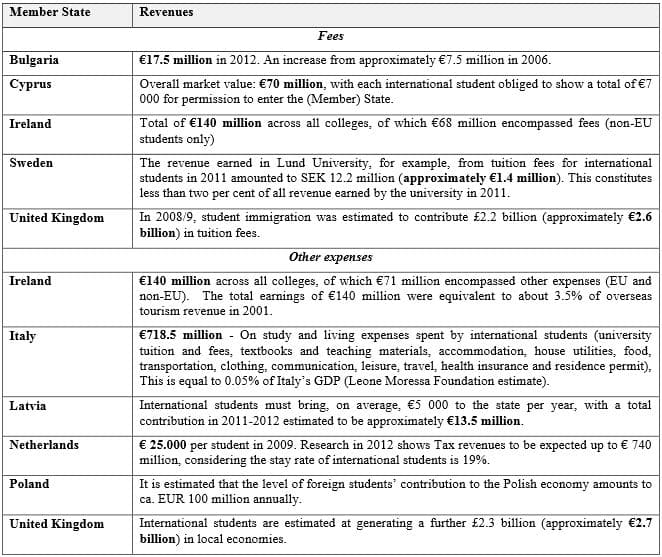
Source:http://monitor.icef.com/2013/05/europe-takes-stock-of-its-international-student-recruitment-strategies/
Social Media And The Job Hunt: Squeaky-Clean Profiles Need Not Apply by Meghan Casserly
 A young friend who just scored her first internship at a NYC recruiting firm recently told me that she’s uncomfortable with her new job description. Instead of filing and sitting in on interviews, she’s spending her summer days in a high-walled cubicle poring over the social feeds of countless candidates applying “mostly,” she says, “for low- to mid-level financial and legal positions.” Her new bosses seem impressed with her comfort with the technology and are pleased with her vetting of new hires, but she describes the task as akin to “stalking crushes on Facebook,” something she’s “gotten embarrassingly good at in college.”
Either way, at 21, she’s become the gate-keeper to employment for thousands of New Yorkers and I was surprised to hear about the barriers to entry. Wedding pictures? Great. Baby photos? Even better. Photos with friends at parties, beaches and concerts? An absolute must.
“There’s a sense that a profile with no character has probably been scraped of some racy stuff or else the person has no social skills and won’t fit in.” Either way, she says, that candidate has been moved to the bottom of the pile.
According to the 2012 annual technology market survey from Eurocom Worldwide, “One in five tech executives say that a candidate’s social media profile has caused them not to hire that person.” Another recent survey shows that 37% of firms across industries browse social media profiles to evaluate each candidate’s character and personality .
But with all of the common wisdom floating around the web (and this site) on how careful job seekers must be about curating (read: editing) their social presence online, it seems to be that our advice might have crossed over from helpful to problematic. In a popular post on Forbes from contributor Lisa Quast in April, she says it’s important to leave out photos from Saturday night’s party in order to communicate a more professional demeanor. With so much time focusing on building a strong professional character on our Facebook pages and LinkedIn profiles we might possibly be leaving out a very critical element: our personalities.
By 2012 experts on using personal branding for professional purposes have really given up the notion of any real distinction between personal and professional presences, which was, until recently, the oft-repeated wisdom for job seekers. But keeping track of two Twitter feeds can be exhausting, and maintaining two Facebook profiles actually violates their code of conduct and could leave you banned from the network.
Instead, at least according to careers expert Joshua Waldman, something of a guru in using social media in the job hunt who gave a talk at this week’sNACE conference on the subject, says that everyone—employed, unemployed and the hopefully-soon-to-be-employed—should adopt a tone of what he calls “Public Private” online. “Think about a TV or radio show host,” he says. “They’re talking about personal details of their lives in a very public way. These details are important because they make themselves seem accessible to listeners but they’re definitely not deep secrets or potentially embarrassing.”
Job-seekers, Waldman says, should keep the public private in mind when posting to social networks or when selecting privacy settings. Aim to post something publicly private to the social graph at least once a week and you won’t wind up on the bottom of an intern’s pile, or worse, become the subject of a more thorough investigation. “Step into the mindset of a celebrity or a public figure,” he says. “There is information about you available online to anyone willing to work hard enough to find it.” It’s better, he says, to tame the lion by feeding it.
 Waldman’s sentiment is echoed by James Alexander, the founder and CEO of Vizibility, an online reputation firm that helps individuals curate, package and distribute their social presence to colleagues, clients or potential employers through links or QR codes on business cards resumes and email signatures. “when people are looking to vet you, as they’re definitely going to, they need to be reaffirmed that you are who you say you are,” he says. For some that will mean a simple web search to see that everything you attest on your resume is true. For others, employers are looking for a social presences that illustrates creativity, engagement in a community or a level of expertise, all things that can be proved or disproved online.
The problem arises though, when a hiring manager (or an intern) hops online, finds one thing he or she doesn’t like, and your likelihood of employment comes to a screeching halt. Alexander’s recipe for success lies in bundling exactly what you want and delivering it on a silver platter. Think your own personal “Best of the Web.” Through Vizibility’s “SearchMe”function you can hand-pick your top five most flattering Google links and even create a specialized query for potential employers. Jane Smiths no longer have to contend with doppelgangers when queried as (“Jane Smith”+”graphic design”+”Austin”+”award-winning”). When a hiring manager looks at yourVizibility profile, she’ll automatically be prompted with mutual Facebook and LinkedIn contacts, and be provided with relevant (hand-picked) links to your work and presence on the web. No searching, no stumbling. Feeding the lion to avoid the pitfalls—quite cleverly, I might add.
Of course, there are also firms out there who make vetting candidates through the social graph their business. Social Intelligence, for example, assembles dossiers of plusses (honors, awards, charitable work) and minuses (references to drugs, explicit photos, evidence or racist or sexist attitudes) on potential hires for its clients. “We’re not detectives,” its CEO Max Drucker told theTimes last year. “All we assemble is what is publicly available on the Internet.”
Other companies have more magnanimous values in finding the best candidates through the social graph, like Reppify, which relies less on Facebook and Twitter and more on culture- or industry-specific networks or message boards to mole out wunderkinds. For engineers, networks like githuband reddit might take precedence or whether a candidate has answered a complicated query onQuora might bump a candidate up considerably despite a less-than-stellar Twitter following or a non-Ivy education.
But more than anything, says Reppify CEO Chirag Nangia, vetting a candidate through social networks is about putting all of the pieces together. Looking at one network alone–whether Facebook, Twitter, LinkedIn or even Klout–could leave you with a troubling top candidate. Take the Biebs. “Justin Bieber may have 23 million Twitter followers, but he’s definitely not the best guy to do my online marketing,” Nangia says. “There’s a whole lot more to it.”
Hiring managers: tell that to the intern.
Subscribe to:
Posts (Atom)